Mahjong Crush: Sorting Jam
- 4.6
- Rating
- 1.00M
- Installs
- Free
- Price
 Analysis by App-foxy
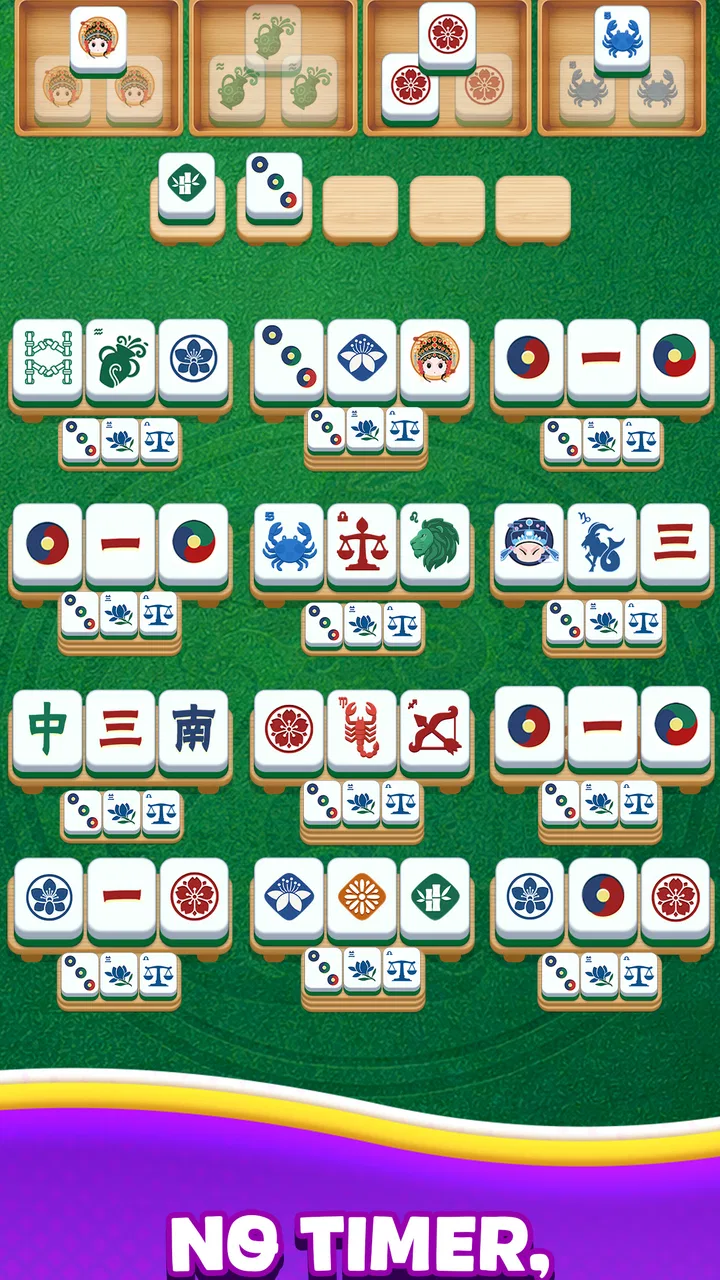
I spent time with Mahjong Crush: Sorting Jam to understand what makes its simple-looking puzzle loop work. Developed by iKame Games - Zego Studio, this free puzzle game combines Mahjong-style tile matching with a sorting challenge. The central idea is easy to grasp: find matching tiles, clear them, and keep the board from becoming an awkward pile that blocks your next move. What matters is how that small rule changes from a calming routine into a careful planning exercise.
My first impression was that it is designed for short, low-pressure sessions rather than long, demanding campaigns. The visual language and basic objective are approachable enough for an Everyone-rated game, yet the sorting element gives each board more tension than a straightforward matching activity. I could begin without studying a tutorial, but I still had to slow down once the available matches became less obvious.
The game is free to download, with optional in-app purchases ranging from $1.99 to $99.99 per item. That makes it easy to try without committing money first, although players who dislike purchase prompts or any form of optional spending should keep that model in mind. With an average rating of 4.4 from around 15 thousand ratings and over 500 thousand installs, it has already found a sizeable audience for this particular blend of relaxation and sorting.
You May Also Like

 Blood Strike: 2.5 Anniversary
Blood Strike’s Loadouts Turn Every Drop Into a Tactical Gamble
A close look at Blood Strike’s custom loadouts: how fast access to signature weapons reshapes its battle royale rhythm, rewards preparation, and narrows the gap between fights.

 Pandora - Music & Podcasts
Pandora’s Music Is Easy to Start, but Harder to Recover
Pandora’s strength is its low-effort path from a seed to a station. Its weak spot is how much confidence it asks you to place in connection, setup, and quiet recovery.

 8 Ball Pool
 Is Built on Rivalries, Rematches, and Routine
A close look at the rivalries, rematches, shared routines, and unanswered safety questions that turn a quick pool match into a persistent mobile community.

 Samsung Music
’s Quiet Strength Is Playing What You Already Own
Its reach comes less from spectacle than from dependable access to a personal library. That simplicity is both the app’s strongest retention engine and its ceiling.

 AccuWeather: Weather Radar
AccuWeather Review: A Quick, Clear Forecast for Everyday Decisions
For everyday plans, the best forecast is the one you can understand quickly. AccuWeather makes rain timing, radar, and local conditions easy to act on, with a few trade-offs.

 Hill Climb Racing
Why Hill Climb Racing Still Turns Crashes Into One More Run
A tiny car, a bumpy hill and one more upgrade: Hill Climb Racing keeps resurfacing because its simple chaos makes every near-miss feel personal.
More From Our News Desk



The matching-and-sorting idea is the real hook
I like how the matching-and-sorting idea asks me to think about what a clear will change, not just which tiles look alike. In this section, I’d focus on reading the board as a set of possible openings and choosing a move that keeps later choices comfortable. That small habit makes the puzzle feel more deliberate, setting up why its best moments come when I give each decision room to work.
Why the capability feels different from ordinary Mahjong puzzles
Traditional Mahjong-inspired mobile games often focus mainly on recognizing identical or related tiles and removing them in pairs. Here, the sorting-jam side changes the way I look at the board. A match is not only a reward; it is also a way to create space, expose possibilities, and prevent the remaining tiles from becoming difficult to manage.
That distinction gives every move two jobs. I am looking for a valid match, but I am also thinking about what the board will look like immediately afterward. Clearing an obvious pair can be correct, yet it may leave a less useful arrangement. A slightly less tempting match can be better if it opens the area I need or keeps several future options available.
The strongest part of Mahjong Crush is that matching becomes a space-management decision. This is what keeps the game from feeling like a purely automatic search for identical pictures. The rules remain friendly, but the order of actions starts to matter.
How the core loop works in practice
In a typical session, I scan the visible tiles, identify a match, and choose whether clearing it helps the overall arrangement. The satisfying moment is not simply seeing a pair disappear. It is recognizing that the removal has made another route possible. That small chain of cause and effect gives the game its rhythm: inspect, commit, reorganize, and inspect again.
I found it useful to resist the urge to tap the first available match. When several choices are visible, I first check which one seems to reduce clutter most effectively. This is a practical habit rather than a complicated strategy, but it makes the difference between calmly progressing and suddenly facing a board with no comfortable follow-up.
The sorting emphasis also makes the experience accessible to people who enjoy organizing things. If you like arranging objects, clearing a crowded desktop, or grouping similar items before deciding what to keep, the board structure has a familiar appeal. The game turns that instinct into a sequence of small decisions without requiring fast reflexes.
A useful way to read the board
I recommend treating the board as a set of priorities instead of a collection of isolated pairs. First, notice the tiles that appear to restrict access to other areas. Next, look for matches that reduce the most visual congestion. Finally, consider whether your choice leaves a useful match for the next turn.
This approach is especially helpful when the board looks busy. Rather than trying to memorize every symbol, I focus on the few tiles that control the immediate shape of the puzzle. That reduces mental noise and makes the game feel more relaxing. It also reveals the main trade-off: a move can be valid without being wise.
Another small tip is to pause after every significant clear instead of tapping continuously. The changed layout can reveal a match that was previously hidden in plain sight. This is one of the reasons the game works well as a quiet break; its best play comes from observation, not speed.
What a normal everyday session feels like
I can easily imagine opening it during a short break after finishing a work task or while waiting for an appointment. One board gives me something concrete to focus on, but the rules are light enough that I do not need to prepare mentally. If I make a poor choice, I can usually understand why the board became harder, which makes the setback feel like a planning mistake rather than an arbitrary punishment.
It also fits the kind of evening routine where I want interaction without a loud story, competitive pressure, or a large amount of information to remember. The matching theme provides a familiar entry point, while sorting adds just enough thought to stop the activity from becoming completely passive.
Where the relaxing promise has limits
The game is most calming when I accept its pace and treat each board as a small organizing problem. It becomes less relaxing when I chase perfect decisions or feel compelled to clear everything as quickly as possible. The same mechanic that creates satisfying strategy can also make a simple session feel unexpectedly fussy if I overanalyze every move.
That is an important distinction for potential players. Someone looking for a completely mindless tile-matching app may find the sorting layer more demanding than expected. Someone who wants a deep strategy game may find it too gentle. Its best position is between those extremes: a casual puzzle with enough planning to reward attention.
When the sorting focus pays off most
The sorting focus feels most rewarding when I want a short, quiet task that still holds my attention. I’d use it during a pause in the day, taking a moment to reassess the layout after each clear rather than tapping on instinct. That makes the experience feel purposeful without turning it into a high-pressure challenge, and leads naturally into the situations where this style fits best.
The best use case is a short reset
For me, the strongest scenario is a ten-minute mental reset. I can start with a quick scan, make a few deliberate clears, and stop without feeling that I have abandoned a complicated narrative or a long competitive match. The board gives my attention a clear target, which is useful when I want to step away from scrolling but do not want to begin a major game.
The sorting mechanic is particularly effective in that setting because it creates a gentle form of concentration. I am not merely waiting for something to happen, yet I am also not under pressure to react instantly. That balance makes it suitable for casual players who want their break to feel active without becoming stressful.
Who may enjoy it with friends or family
Because the basic objective is easy to explain, it can work as a shared puzzle conversation. I could show a board to another person and ask which match they would clear first. Even without a formal multiplayer feature, discussing the best order of moves adds a social layer to the decision-making.
The Everyone content rating also makes the concept broadly approachable. Still, “easy to understand” does not mean every player will enjoy it equally. Younger players may appreciate the visual matching, while adults who enjoy tidy systems may be more interested in the consequences of each clear. The game has room for both kinds of attention.
How it compares with familiar alternatives
Compared with a basic match-three game, this experience feels less dependent on creating chains or reacting to a constantly changing grid. The focus is closer to recognizing relationships and managing what remains. That makes it a better choice for a player who prefers deliberate sorting over rapid combinations.
Compared with a traditional Mahjong solitaire app, the sorting-jam influence gives the board a more immediate sense of clutter and organization. I am not only searching for a legal pair in a fixed arrangement; I am thinking about how the removal changes the working space. Players who want a purely classic Mahjong structure may prefer a more traditional alternative, while those who like a tidying sensation will probably find this version more inviting.
It also differs from highly competitive puzzle games because its appeal is not built around speed, rankings, or difficult execution. That is a strength for relaxed play, but a weakness for anyone who needs constant challenge or a strong competitive target. The right comparison depends on whether you want calm pattern recognition or a more intense test.
The trade-off between simplicity and depth
The rules are a major advantage when I want to play immediately. I do not have to learn a large set of tile powers or understand a complicated progression system before the first useful decision. The downside is that the experience may feel repetitive to players who need dramatic variety in every session.
Its depth comes from move order and board awareness, not from a long list of mechanics. That gives the game a clean identity, but it also places a ceiling on how much complexity it can offer. If you are searching for a puzzle with elaborate builds, layered objectives, or a story campaign, this is probably not the right destination.
Free access and optional spending
Being free makes the game easy to test, which is valuable for a casual puzzle. I would begin without spending anything and decide whether the basic loop holds my attention over several sessions. Optional purchases are available from $1.99 to $99.99 per item, so anyone sharing a device should be mindful of the purchase model and use the relevant device safeguards.
I would not judge the game solely by the presence of purchases, but I would judge whether the free experience feels comfortable for my own habits. Players who are happy to play casually and ignore optional extras may find the arrangement reasonable. Players who prefer a completely purchase-free environment should choose a different puzzle category or check the in-game flow carefully before settling in.
What the current release means for a new player
The current version is 1.58.0, and the game runs on Android 7.1 or later. That relatively broad operating-system requirement makes it practical for people using older compatible Android devices, although actual comfort will still depend on the phone or tablet’s general condition.
The release date is February 11, 2026, so I would approach it as a relatively recent entry rather than a long-established classic. Its current audience size and rating suggest that the concept is already attracting attention, but the most important question remains personal: do you enjoy the specific combination of matching and arranging, or do you want a different kind of puzzle rhythm?
Who gains the most from this design
I think the best fit is someone who wants a relaxing puzzle but still enjoys making small plans. You will probably get the most from it if you like visual order, prefer short sessions, and enjoy noticing how one clear affects the next decision. It is also a good option for players who find conventional Mahjong solitaire a little too static but do not want a fast arcade experience.
It is less suitable for people who need a strong story, competitive matchmaking, or a constantly expanding set of complex systems. It may also disappoint players who expect every puzzle to be solvable through quick pattern recognition alone. The sorting element asks for patience, and that is precisely what makes it appealing to one audience and less appealing to another.
My final recommendation
After playing it, I see Mahjong Crush as a focused casual puzzle rather than an all-purpose game. Its value comes from one clear capability: turning tile matching into a question of arrangement and timing. That idea is simple enough for a quick break, but meaningful enough to reward players who stop and read the board before acting.
I would recommend it to a friend who wants a calm Android puzzle with a little more thought than ordinary matching. I would start with the free version, use deliberate rather than rapid taps, and judge it over several short sessions instead of one quick impression. If the pleasure of clearing and reorganizing a crowded board sounds satisfying, this game has a good chance of becoming a dependable small escape. If you want deep strategy or high-energy competition, another puzzle style will serve you better.
FAQs for Mahjong Crush: Sorting Jam
01What is Mahjong Crush: Sorting Jam?
Mahjong Crush: Sorting Jam is a unique puzzle game that combines traditional Mahjong elements with innovative sorting mechanics. Players match tiles to clear the board while managing different layers and levels of difficulty. It's designed for both casual gamers and puzzle enthusiasts, offering a fresh twist on a classic game.
02Is Mahjong Crush: Sorting Jam free to play?
Yes, Mahjong Crush: Sorting Jam is free to download and play on both Android and iOS devices. However, the game offers in-app purchases that allow players to buy power-ups, extra lives, and other enhancements. These purchases are optional and not required to enjoy the game.
03Does Mahjong Crush: Sorting Jam require an internet connection?
While Mahjong Crush: Sorting Jam can be played offline, certain features like leaderboards and daily challenges require an internet connection. Playing online also ensures you have the latest updates and access to any new content or events the developers release.
04Are there any age restrictions for Mahjong Crush: Sorting Jam?
Mahjong Crush: Sorting Jam is suitable for players of all ages. The game features family-friendly content with no explicit material. However, parents should be aware of the in-app purchases and may want to set restrictions if younger children are playing.
05What devices are compatible with Mahjong Crush: Sorting Jam?
Mahjong Crush: Sorting Jam is compatible with most modern Android and iOS devices. It's optimized for smartphones and tablets, ensuring smooth gameplay and stunning graphics. Users should ensure their device is running the latest operating system for the best experience.
Pros
- Engaging and colorful graphics.
- Intuitive controls for easy play.
- Variety of challenging levels.
- No intrusive ads during gameplay.
- Regular updates with new content.
Cons
- Limited free hints available.
- In-app purchases can be pricey.
- Requires constant internet connection.
- Some levels feel repetitive.
- High battery consumption on older devices.

Mahjong Crush: Sorting Jam
Gallery